The Best Times to Trade Forex Currency Pairs (Part 2)

Note: If you have not done so already please read part 1 first: The Best Currency Pairs to Trade
 In the first part of this article we discussed which currency pairs are the best to trade and explained the differences between the majors, crosses, and exotics. Today’s article is going to pick up where last week’s left off; we are going to discuss the best times to trade the forex market and the differences between the various FX trading sessions.
Since you have read part 1 and you now know which currency pairs to focus on and why, it is important that you understand when the different forex trading sessions are, how they differ from each other, and the best times and days to trade.
It is true that the forex market is open 24 hours a day, but that doesn’t mean the market is active and worth trading for the entire day. The idea is to trade when the market is the most volatile, because volatility means that a market is moving, and money is made when the markets are moving, not when the market is quiet and calm.
As a price action trader you should be especially excited about volatility, because price action strategies thrive in volatile market conditions due to the fact that they simply reflect the dynamics of price movement and provide you with easy to identify setups which allow you take advantage of volatility.
When are the various forex trading sessions?
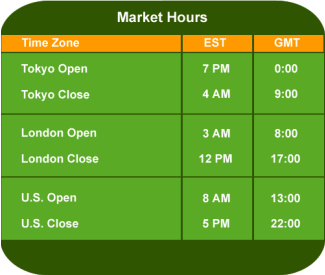 The 24-hour forex market trading day can be broken up into three major trading sessions:
(Note: The chart to the right reflects the Tokyo open and ignores the Sydney open, we have included the Sydney open in the description below, which is an hour earlier than the Tokyo open. All times are based off summer hours in the Northern Hemisphere, the Asian session opens at 4pm EST during winter hours with the market opening in Sydney, London and New York hours remain the same)
• Asian trading session (including Australia and New Zealand): the Asian trading session opens at 6:00pm EST and closes at 4:00am EST
• London trading session: the London trading session opens at 3:00am EST and closes at 12:00pm EST.
• New York trading session: the New York trading session opens at 8:00am EST and closes at 5:00pm EST.
You will notice that in between each trading session there is a window of time where two sessions are operating at the same time. From 3:00 – 4:00am EST, the Asian and London sessions overlap, and from 8:00-12:00pm EST, the London and New York sessions overlap.
As you may have guessed these over-lapping periods within the three trading sessions are the times when volume and volatility rise to peak levels. The over-lap of the London and New York trading sessions between 8am and 12pm EST is typically the best time to trade, because this is when the world’s two most active trading centers cross; as the London session is closing the New York session is opening. Many traders strictly trade this four hour time window because it is typically a very volatile and liquid time to trade the forex market.
The Asian trading session:
The Asian trading session begins at 6:00pm EST as trading gets underway in New Zealand and Australia, an hour later at 7pm EST Tokyo opens up. Tokyo is the financial capital of Asia; it is also worth noting that Japan is the third largest forex trading center in the world. The yen is the third most traded currency, involved in about 19.0% of all forex transactions; overall about 21% of all forex transactions take place during the Asian trading session.
• Financial hot spots of the Asian trading session include; Tokyo, Hong Kong, Singapore, and Sydney.
• Liquidity is sometimes thin during the Asian session, this is why many FX traders avoid the Asian session and opt to trade the London / New York sessions instead. That said, price will sometimes make powerful moves during the Asian session.
• Major news releases for New Zealand, Australia, Japan, and China come out during the Asian session, so the NZD, AUD, and JPY currency pairs tend to move more than the others during the Asian session. (Chinese economic policy can influence other majors currencies even though China does not allow their currency to float on the international exchange)
• Generally speaking, if the London and New York sessions result in big moves, you will see consolidation during the Asian session.
The London trading session:
As Asia comes to a close the London trading session gets underway. There are several major financial centers scattered around Europe, but London has historically been the center of all forex trading. About 30% of all forex transactions take place during the London trading session.
• Due to the fact that the London session over-laps with the Asian and New York sessions, it is typically the most active trading session and this leads to high liquidity/volume and lower pip spreads.
• The London session usually sees the most volatile market conditions because such a large amount of transactions take place during this trading period. Remember, volatility is good for price action traders since we deal with the core price data of the market, instead of secondary indicators that lag price.
• Major European news releases mainly come out during the London trading session, this means the GBP, EUR, and CHF are all typically the most active during the London session.
The New York trading session:
The New York trading session gets underway at 8:00am EST, this is just about the time traders in London are getting back from their lunch breaks, and it also signals the start of what is on average the most active time period for forex trading; from 8am EST to 12pm EST.
• Between 8am EST and 12pm EST there is high liquidity as the London and New York sessions overlap.
• The majority of all economic reports are released around the start of the New York trading session since both Europe and New York are open at this time. All USD and CAD economic news comes out during or near the New York trading session.
• About 85% of all forex trades involve the U.S. dollar, so any currency pair involving the USD has the potential to make a big move during the New York trading session.
• After European markets close, volatility and liquidity tend to die down during the late-afternoon New York trading session.
• The New York close is very important as it marks the end of the forex trading day, it is important that you use New York close charts because many price action setups form as the trading day comes to an end.
What does it all mean?
If you have no time constraints or you have a job that allows you to get on the internet and check the charts periodically, the best time to trade is from 8:00am to 12:00pm EST during the New York and London session overlap. Both the London and New York trading sessions are excellent times to trade overall, so no matter where you live in the world you should be able to find a time that works with your schedule.
However, you can trade successfully purely off the daily charts, and it is also a much more stress-free way to trade, this means you can check the charts around or shortly after the New York close each day at 5pm EST. If you employ my “set and forget forex trading strategy” on the daily charts, you will only need to check the market once or twice a day for a short period of time.
The Asian trading session tends to be the least volatile, so if you are looking for big moves to occur, you are likely going to be waiting until trading gets underway in London around 3am EST.
Sundays are typically not worth trading because movement is very low and nothing significant has happened yet to set the currency pairs in motion. The best days to trade based on average daily trading ranges for the “majors” are Tuesday, Wednesday, and Thursday, Friday can be good to trade too up until about 12pm EST when London closes. Monday typically sees lower average trading ranges for the majors, but this doesn’t mean you should avoid trading on Monday, it just means it is statistically less likely that there will be large forex price movements on Monday than the other weekdays.
Remember, being a price action trader means that you need to pay most of your attention to learning to spot high – probability price action trading setups in the Forex market. In the end, what really matters is obtaining a high quality Forex trading education in price action analysis, this way you won’t really need to concern yourself with analyzing economic reports and the thousands of variables that contribute to FX price movement each day. If you want to learn how to trade the Forex market with a handful of simple yet effective price action forex strategies, check out my price action trading course.
Nial Fuller is considered a leading ‘Authority’ on Price Action Forex trading strategies. If you want to learn more about harnessing the power and simplicity of Price Action Trading Strategies please visit Nial Fuller’s Forex Trading Course & Traders Community Page Here. Nial’s Students get lifetime access to all of his advanced price action Forex Courses, video lessons, webinar tutorials, daily trade setups newsletter, live trade setups discussion forum, traders support line & free ongoing course updates. For more information visit the Forex Course page here.


About Nial Fuller
Nial Fuller is a Professional Trader, Investor & Author who is considered ‘The Authority’ on Price Action Trading. His blog is read by over 200,000+ followers and he has taught 25,000+ students since 2008. In 2016, Nial won the Million Dollar Trader Competition. Checkout Nial's Professional Trading Course here.


Wao, this is awesome, by this, i can correct myself on the mistake I’ve been making all these while. Thank you Nial Fuller.
Nice one Nial, very helpful
Amazing article. Thanks Nial.
Great knowledge.
Thanks
Sir Nial, your explaination on the best time to trade FX market is really very informative and simplifying. Thanks a lot for your good work of empowerment. Keep it up brother!
Thank you very much, God BLESS YOU
Nice Post.
I like It.
Thank you have learnt a lot.
Woow, that was so very much empowering.
Matsi, Polokwane RSA
Thanks man. U r a straight talker. My hat is off
Tnx for the amazing article Nial. You are an amazing teacher. I have been wondering what the best currency pairs were and when to trade them for over a year now. Tnx to you I finally know!
Hi
A newbie in Forex Trading your lessons make sense and are informative. I will follow your instructions/education
thank you now i know the difference between GMT —EST our local time in Africa
This good!
Excellent articles. Straight talking. Even a relatively inexperienced guy like me can get real value from this well explained / minimum jargon approach………..well done and thank you.
thank i learn more of the trading strategiest
Thanks Mr Nial
Thanks for this powerful articlr
Thank you very much for this wealth of knowledge you have given me through your article
very informative good work . it help to understand the market timing.
Powerful article mentor Nial! You make trading forex simple and understandiable for a newbie like me!!!
thanks for this great knowledge master
Powerful information u have imparted to us Master Nial! God bless u abundantly!!
Powerful information professor Nial! U make trading forex simple!!!
Nial you are God sent to we traders, God bless you always.
Thanks.
Great,v.informative
thanks for the info
Thank you so much Nial.
Nial,
i read all this stuff before but i wish i would have read yours first because it is so concise and wisely put together. thanks a lot and i will have more questions for sure.
have a great week and good trades to everyone.
Thank you Nail, very clear and informative. You have answered my mail and more…
Thanks for great article Nial! God Bless You!
You are the best,article is clear and It Explains in a very simple and easy Form.Thanks for take your time and all Your help.
Really very very helpful!!
Thanks for increasing R:R (return:risk)ratio!!
You are the most define Forex writer i have ever met.your articles are very power and very enlightening.God bless you sir.
osagie from nigeria
GOD BLESS NIAL FULLER.
Recently I have found the best time for my trades with the Yen crosses are about an hour or two after Tokyo opens (7am EST), but closing out or moving my stops before going to sleep during the London sessions. Also I have been watching the Japanese Yen Cash (J6Y00) futures chart and it has really helped with direction on the spot price for the Yen pairs.
Finally, I got it. Keep teaching me your great lesson, please.Thank you for allowing me absorbing your lesson. Someday I will inevitably take the advance course :D.
well…I still do not know when all those times are in my “local” time…doh…lol
This article is a very concise and precise sypnosis of the useful trading times. Typical of the Forex King,- Nial, no BS, straight to the point. Much better than the so called Fx expert talks. Thank you.
Nial,
You article has given me the fundamental pre-requisites required before trading Forex. I have not started but will start soon using your strategy.
God Bless You
Once again a great, concise and very helpful article Nial. Thanks for sharing.
Thanks Nial for sharing. A great article for all who starts learning and trading forex.
What a clear lesson for trading on Forex. thanks Nial for sharing
Well done Nial, your information contains non of the BS usually associated with Forex sites. I wish you good luck for the future and keep up the good work, we all know it pays back in the end!
THIS PART OF YR LESSON IS WONDERFUL I WISH YOU SPOON FEED US WITH THE CURRENCY PAIRS IN LINE WITH THE SESSONS.
A very clear and detailed introduction for the best times to trade the markets. Thankyou.
Muchas gracias de nuevo, me encantan tus articulos.
Very useful information, very important and very explanatory.
Thank you.
Nial, From one Ozzie to another thanks. Very clear commonsense
advise worthy of many reads. Cheers Brooky
Nial. thanks this is another great eye openner. ohuizu
Thanks for every article on your site. Very good job! I think it’s very helpful for newbies and confused forex traders!
Thanks; very nicely explained.
I find myself reading some of these articles Again as they are honest and very encouraging.
Thanks nial
Thanks Nial, very useful info
thanks for your articles, just wonderful.
Nial,
Thanks to your articles I think I can trade successfully part time. I’ll be signing up for our course as soon as I can afford it.
regards
Michael
Nial,
An insightful article. My thanks and regards
Ajith
Nial I highly appreciate your explanations about the market.they makes a huge impact on my trading..THANKS..and now I always win
Thanks Nial,great article
Thanks Nial, as usual clear and concise explanation
Very interesting and Its true. Keep on doing good work.
Thanx Nial for this part 1-2 sessions. As always you explain all very clear.
Your the man.
Good info. Thanks Nial
You are a great guy,you never disappoint in your write-ups.Thanks
very useful and practical information, well done and thank you for impacting nations with your articles, God bless you!
Thank you Nial for very useful information I appreciate it very much.
take care and keep up great job
Igor from Stockholm
Thanks again nial, great info.
thanks Niall
very informative and as always very educational
thanks
stay well
thanks for this this months articular you have answered my previous question which i think i emailed you
thanks a million
This makes sense.
Thanks for these essentials.
Hi Nial,
Many thanks.
I am very glad I live in the UK.
Talk to you soon.
Don
Everything you teach makes absolute sense with its clarity.
Insightful as always,Good one Nial…More power 2 ur elbows
Thanks Nial, u r awesome.
Your articles are clear and informative. I appreciate very much.
I ve decided to sign up for your course coz i ve high respect for you. You can be a great mentor to me.
God Bless u.
Great article from our exquisite forex pro.thanks
Thanks Nial, another good article!
Really interesting!
I’m going to print this lesson and make it a part of my trading plan.
I found Fridays to be the worse day for trading. The market is very unpredictable possibly because traders close their positions at the end of the week. I would only monitor any open positions on Fridays but never place new trades.
Great article! You Always explain in a very simple and easy way to understand. Thanks.
Thanks Nial,am so impressed .this is excellent you articles and videos has taken me to the next level! Keep it up brother. ONE LOVE..,!
Thank Mr.Nial for your great time information. Now I am not a born looser anymore. Anyhow thanks again
Nothing like the American market open – lunch. Great article and many trader’s need to make a decision about when they trade and stick to it!
Very simple, clear, yet solid details. Very suitable for newcomers.
Excellent article
Question – do NY, London and Tokyo traders commence at 8 AM and close 5 PM local time as the times you have quoted would change a little due to summer and winter time changes?
John
Hi Nial
Thanks for all the help and support over the last few months.
Great article.
Making good money now, which is what’s its all about.
Your course was the best investment I have ever made.
Keep the advice coming!
great info thank you Nial!!!!
Nial:
Excellent article and really puts trading zones in perspective. With price action using daily charts this information is really not as important as all your previous teachings. Well written article just the same…
Ty
Thanks Nial,
More confirmation as to when to trade. One thing to keep in mind is your health and relationships. Which is to say, get your sleep/rest and a quote I heard recently, “Happy wife, Happy life”.
Great work Nial. Your articles are much appreciated.
This is simply awesome advise. Learning not to over-trade is a skill nonetheless.
as usual great article , if one can trade only in EU session , what are the best time ? care to enlighten
pls keep coming on the articles, is important not only know “HOW” but also “When” and “What” , the two article provides the information on “what to trade” and “when to trade”…..nice….
Excellent article. Very informative …
Mr. Fuller
I appreciate the article, thanks.
Everything you do is excellent Nial. I am a member of your course and loving it. This article part 2 is big help, as was last weeks article part 1. Thank you sir.
Nial, I bought your course and trainings last week, I just wanted to say a big thank you and congratulations on the success of your community and thank you for all your lessons. Your help and trainings are superior. I made good pips on the EURUSD 4 hour fakey last night, Thanks again.
Romad
As usual Nial a very clear and well laid on piece. No complicated confusing stuff, just plain understandable information.
Thanks Nial, as always, another great lesson.