Risk / Reward – The Holy Grail of Forex Trading Money Management

 If you were stranded on a desert island and somehow had access to the internet, a computer, and electricity, and you could only have one Forex trading educational article to read, this would be the article you would want to have…
A simple fact of Forex trading is that it is a game of probabilities, those traders who learn to view and think about trade setups in terms of risk to reward, are the ones who usually end up making consistent money in the Forex market. There is something to be said for developing your discretionary trading skills, as having a sharpened sense for spotting well defined trade setups at the right place and time is definitely a necessary ingredient to successful trading. However, it is possible to make consistent money even if your discretionary trade setup identification skills are not fully matured yet. Risk to reward setups are what give all traders an equal chance at making consistent money, a thorough understanding of risk to reward and how to view trade setups in terms of possible risk to possible reward, is the closest thing to the “holy grail” of trading, and is one of the most important pieces of the puzzle to consistently profitable trading, second only to having the proper amount of self-discipline and emotional control.
• Drawing risk / reward levels
The first thing that all traders should do upon spotting a price action setup, or any trade setup, is calculate the risk they will have to take on in order to give the setup a realistic chance at working out. Traders often make one or two mistakes when it comes to determining risk; they either define the reward first, which is a mistake born out of greed, or they put a stop loss on the setup that is much too close to the entry to give the trade a chance at working out.
When learning to think in probabilities and to view the market in terms of risk to reward, it is necessary to calculate the risk on a trade setup first, then you can calculate the reward as a multiple of the amount you have at risk. By concentrating on the risk first, instead of the reward, you are making yourself more aware of the risk involved on each trade setup, instead of becoming fixated on how big of a reward you might make, as many traders do. This will also turn you into a “risk manager”, rather than a “trader”, the best traders in the world know that consistent trading profits come as a result of managing risk effectively, so consider yourself a manager of risk from now on.
The next thing to do after you have identified a high-quality trade setup and marked the risk level on your chart, is to mark the reward levels as multiples of your risk. You want to draw a line at 1 times your risk, 2 times your risk, and 3 times your risk. These are the reward levels you will mainly concern yourself with, should you choose to employ a trailing stop you can use these 1, 2, and 3 times risk levels to begin the trailing process, see the section on “trailing stops” below for more.
Examples of how to draw risk / reward levels:
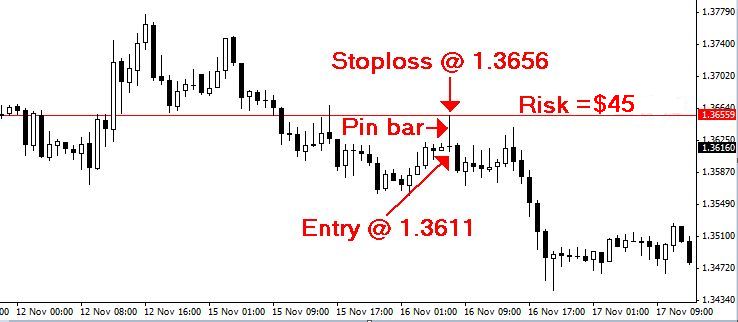
First, we identify a high-quality price action trading setup, in the chart below we are looking at the 1hr chart of the EURUSD from this week. A quality 1hr pin bar sell signal formed at a confluent intra-day resistance level and in the direction of the bearish momentum on the daily chart.
Next, we mark our risk level for this setup, in this case the risk is the distance from the low to the high of the pin bar, so we place a stop loss at 1.3656, one pip above the high, the entry is a break of the low, so 1.3611 is our entry level, one pip below the low. The total risk distance for this setup is 45 pips, we will figure 1$ per pip for the examples in this article, so our risk is $45, not 45 pips. Since you can trade various numbers of lots per pip, your actual risk is not calculated in pips, but in dollars, many traders make this mistake. Remember; always calculate your risk and reward in dollars, not in pips, only use pips to mark the risk and reward levels on your charts. (we expanded on this in this in our forex money management article here )
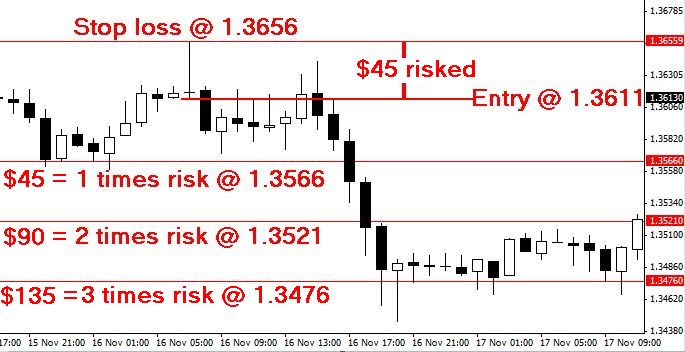
Now we can use this measure of 45 pips to mark our 1, 2, and 3 times risk multiples. Since our risk (R) is $45, our 1R multiple is $45, or 2R multiple is $90, and our 3R multiple is $135. Since our stop loss distance is 45 pips, we subtract the 1, 2, and 3 multiples of 45 from our entry point of 1.3611; we then get the levels marked on the chart below. This setup obviously worked out quite nicely as all three risk multiples got hit, for a reward of 1 to 3. It is worth noting that trade setups on the smaller time frames are more likely to hit larger risk multiples since your stop loss will usually be tighter than it will be on a higher time frame. The trade is now set up, time to let the market get to work.
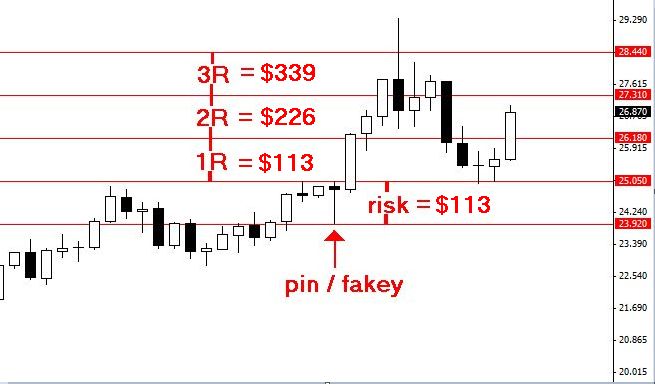
In the chart below we are looking the daily Silver market, we can see a quality pin bar fakey combo setup formed with the dominant bullish market momentum. We first marked our risk distance which was 1.13; we then multiply our risk (1.13) by 1, 2 and 3, to get our (R) risk multiple levels. We can see them drawn in on the chart below and also that this setup easily brought traders a risk / reward of 1 to 3 before forming another very nice pin bar strategy that sent prices lower. This example also figured 1$ per pip, or per smallest incremental price movement on silver, this results in $113 risked.
• Trailing stops
If you decide that you want to try and let a particular trade setup run, you might want to employ a trailing stop strategy with the aid of risk / reward levels. The best way to do this is to mark your risk and reward levels just as described above, but instead of actually entering an order for your reward levels, you leave the trade open, meaning you don’t have a set exit at your pre-defined reward levels. Instead, once the market moves in your favor, you use your pre-defined reward levels to trail your stop loss to, thus leaving the trade open and giving yourself a shot at greater profits, while still locking in some profit and lessening risk.
A common technique to use when trailing stops to risk / reward levels is to trail the stop up to your entry level when the trade is up 1 times or 2 times your risk. You can also trail your stop 50% closer to your entry once you are up 1 times risk if you want to leave the trade more “breathing” room. Many traders will simply keep their stop 1R multiple away, meaning if you are up 1 to 2, you trail your stop up to lock on 1 times your risk, if the market than moves 1 to 3 you trail your stop up to lock in 2 times your risk. This is a solid trailing technique because you are securing profits while at the same time leaving the trade open for a possibility at it running further in your favor. This technique is best used in strong trends. Many traders make the mistake when trailing stops of not properly locking in profits, there is nothing worse than letting a winning trade come all the way back to your entry point because you didn’t lock in 1 or 2 times your risk.
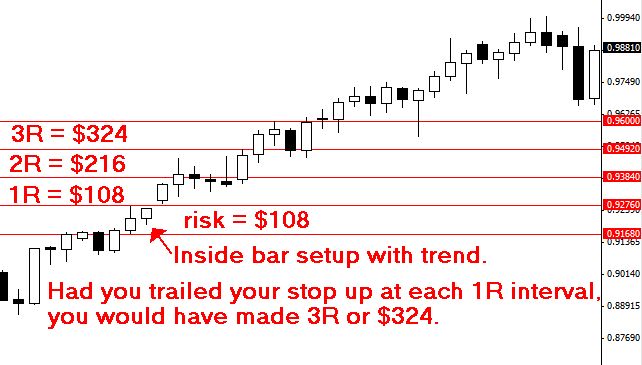
The daily AUDUSD chart below shows an inside bar setup that occurred back in mid-September of this year when the AUDUSD was in the midst of an uptrend. In this example you could have moved your stop to break-even once you were up $108 or 1 times your risk, once you got up 2 times risk you could have locked in 1 times your risk or $108. It looks like the market hit 0.9600 or 3R and then pulled back into 2R, however it came about 1 pip shy of 3R on its first attempt, so you would not have moved your stop up until it cleared 3R a couple days later. At this point you would have 2R or $216 locked in, at this point you could either let the trade run past 3R or move your stop up to lock in 3R or $324. If you moved up to lock in 3R right away you would have got stopped out at 3R by the pin bar on September 5th, had you not locked in 3R you could have eventually made 4 or 5R.
• How risk / reward can make you a consistently profitable forex trader
Ideally, we want to look for trade setups with a risk / reward of at least 1 to 2, by getting a risk / reward of 1 to 2 on every trade setup, we can lose on well over 50% of our trades and STILL make money. This is why risk / reward is the “holy grail” of trading; if you execute it properly you can make consistent money over a period of time. However, many traders mess it up or limit its power by meddling in their trades once they are live, usually this means they take less than a 1 to 2 profit, and then enter another trade that is lower-probability, and maybe take a loss. Once you start this game of meddling with your trades and interfering with the power of risk reward scenarios, you really put limits on what you can achieve as a forex trader.
To play with the numbers a bit let’s discuss a scenario where you lose on 65% of your trades, but your risk to reward on every trade is 1 to 2. So, out of 100 trades you lose on 65 of them and win on 35 of them, let’s say you risk $100 per trade. This means you lost 65 x $100 = $6500, but since you made 2 times your risk on your winners you made 35 x $200 = $7000. So, after 100 trades you have a profit of $500, this is even after you lost on 65% of your trades! This is an example of the power of risk / reward setups, the trick is that it takes time to play out, most traders do not have the discipline to execute 100 trades flawlessly with a risk / reward of 1 to 2 and suffer through 65 losses and only 35 winners.
The lesson to be learned from this article is that you can make still money in the forex markets even if you lose far more trades than you win, IF you understand and properly implement risk to reward scenarios on every single trade you take. You must combine this knowledge of risk to reward with a plethora of self discipline, you must understand that you cannot waver or second guess yourself, if you are trading a solid trading strategy like price action combined with risk reward knowledge and self-discipline, you have the potential to be an unstoppable trader. To learn more about price action trading and risk to reward, check out some of the other cool parts of my website and my price action trading course.
Good trading, Nial Fuller
I WOULD LOVE TO HEAR YOUR THOUGHTS, PLEASE LEAVE A COMMENT BELOW :)
Any questions or feedback? Contact me here.


About Nial Fuller
Nial Fuller is a Professional Trader, Investor & Author who is considered ‘The Authority’ on Price Action Trading. His blog is read by over 200,000+ followers and he has taught 25,000+ students since 2008. In 2016, Nial won the Million Dollar Trader Competition. Checkout Nial's Professional Trading Course here.


Very eye-opening and impactful insight into the art of entering a trade and knowing how to manage it from a perspective of risk/reward for the best results. I read about risk/reward & SL but this has given me a better understanding of them.
I love the way you explain Price Action trading strategy, most easy to understand thanks sir.
Great Read Nial… Love Your Articles… Appreciate It… I Now Have A Better Understand Of R/R
THANK YOU…
Good article great staff
To play with the numbers a scenario where you lose on 65% of your trades, but your risk to reward on every trade is 1 to 2. So, out of 100 trades you lose on 65 of them and win on 35 of them, let’s say you risk $100 per trade which leaves your account size at $10000. This means you lost 65 x $100 = $6500, and since you made 2 times your risk on your winners you made 35 x $200 = $7000. So, after 100 trades you have a loss of $3000 which is equivalent to 30% loss on the account, which translates to the fact that you need a risk/reward ratio of above 50% to consider yourself profitable with a risk / reward of 1:2, losing 65% and winning 35% only puts you at a drawdown of 30% on your account. In conclusion 65% loss on trades with a 1:2 risk / reward is not profitable however can be with a 1:3 risk / reward ration, hope this helps
Based on the example of 100 trades and with a 1:2 Risk to Reward ratio, if you have lost 65 trades with a $100 risk per trade, then in total, you have lost $6500, and the remaining 35 winners would have made you $7000 (By using 1:2 Risk to Reward ratio), you would have ended up making $500 in Profit.
Hi, you have lost $ 6500 by 65 losing trade. Then you have $3500 from $10000.
Then, you have won $7000 by 35 wining trade.
Now, you have total $3500+$7000= $10500.
Therefore, your profit $10500-$10000=$500 simple.
Simple and powerful advice.
Much appreciated for helping Mr Nail.
Getting to understand the ‘risks and rewards’ way better.
Very Nice article indeed full of logic and a lot of sense in it.
Thank’s sir, for this great idea. But please sir, i have some questions which are 1, how do i do the risk/reward setting? 2, how do i lock in profit? Am new here.
Hey, Nial! Thank’s a lot for this article!
This information transform all pieces of puzzle into one solid knowledge about consistent profits in trading.
Very useful!
great article Nial,thanks.
Hello Mr Nial thanks for this article but I would like to get something straight let’s say I am using the first method and I am trading with a lot size of 0.60 per lot do I have to divide it into 3 parts of 0.20 per lot and allocate the various reward levels (R1,R2,R3) to each of them. Would really appreciate your reply sir
Chris
Hi, Chris
Here lot size is not fact. Fact is how much risk you want to take. Say, you want to take risk $90, so you can divide $90 into 3 parts. So your risk $30 for each entry. $90 for 3 entries at same price level for various reward levels.
Therefore, you have to fix the lot size based on $30.
Then, you can take different lot size for different stop loss level from entry level.
Example,
Lot size 0.6 when stop loss level 50 points away from entry level.
Lot size 0.1 when stop loss level 300 points away from entry level.
Lot size 0.05 when stop loss level 600 points away from entry level.
All above cases loss will be $30 if hit the stop loss.
Use realistic stop loss point based on price action setup.
Thanks.
Excellent article.
Bookmarked this one.
It is really great and fantastic article. Really thank you very much. These writings have the power to change one’s mindset completely and can turn he or she to a big profitable trader.
Thank u very much.
I have one small question that all these lessons must be applicable to Equity stocks equally. Isn’t it? Or any change in needed there? Please confirm.
Mmmm nice one I will have a look at it again.
Thank you Nial. Btw lets do it.
I like u to send me simple useful tools that can aid my success in Fx trade. Thank u for your works.
Excellent article Nial
Simple, logical and easy to comprehend.
Thank you.
I’m lucky to read this topic , Thank you Mr,Nail for helping
very good artical, thanks Nial
Thank you, i now get it especially about trailing stops with risk/reward.
one of my fav!!! thanks
Super….Excellent…..go on…….Nail
Nial, I have read this risk/reward article many time over and over. To my amazement, the one thing that was missing is I was not applying it. Yes I started out with good intention but would always go back and get out of the trade early. Taking a 1r/.5r or taking a 1r/1.1r. Yes, Nial you must do it the correct way if you want it to work.
Thank you, Nial
Love the intro! Again a superb article that will change anyone’s trading future. Thank you for sharing ^_^
Thanks Nail, and I want to say that no body know how much every trade will go with profits, so I think that lots of times I should close apart of the trade as a first targein an 1/2R then make trailing as possible as I can. Do you think will it be profitable on long term?
I will be glade to hear your opinion
Another very good article Nial, thanks for sharing your valuable knoledge.You are a truely good trader and teacher. thanks again!
One of the most helpful articles on your site. I gave it a quick skim a while ago, finally returned to it today and gave it a closer look.
Thanks, Nial.
Nial, thanks, as always, a great article. I have a comment and would be happy to hear your view on this.
Surely 2R is better than 1R.
At the same time, we need to be clear that if our TP level is further away (to get a higher R), then the probability of hitting the TP gets smaller!
Expectancy of a trading system = % winning trades * avg $ gain of the winning trade – % losing trades * avg $ loss of a losing trade.
When we increase the R ratio, we are increasing the avg $ gain of the winning trade vs. a $ loss of a loser, which is great, but we are also decreasing the percentage of winners, which is natural consequence of having the TP level further away. Question is where the optimum lies.
I guess it will depend on individual trader psychology, the market situation, as well as a given setup.
Thanks again and all the best.
Michael
Very plainly stated, the advantages of r/r. To calculate the risk first and use that to multiply reward makes all the sense of a prudent plan. I greatly appreciate the detail of the content you provide freely and on such a wide variety of issues. Tempted to sing-up for the price action course however, I am still digesting the free content. Thank-you very much please know that your information is first rate and so worth the time!!!! Awesome Nial Great stuff
hello thank you for sharing.
good job.
good luck.
bye bye .:)
This is definitely the most important fact one needs to know in forex. Thanks Nail, you’re great!
Nial,
Thanks so much for your willingness to share your wealth of knowledge, and for being such a fabulous teacher. I have watched almost all of your free videos and read most of your articles numerous times in the past week. Now I am making money way faster than I lost my initial 50% of my first mini account. This article was the most valuable of them all to me.
Many, many thanks. I will see you in the member’s section shortly ;)
Mimi
Hi Nial,
I am a beginner in trading with a target to become the jack of the trade. As my initial effort, i extensively googled for information on how to trade and what is the logic and strategy behind success. I got lots of manuals and articles from many people which made me feel that i am trying to climb the Mt. Everest. But, When i came across your article i realized that trading isn’t a herculean task. I could feel the confidence within me filling. Believe me, I am kind of addicted to your articles that i read the same articles over and over because each time i read them i can see a smile of confidence on my face. Anyway, i still do have a number of queries. I will be registering to your full course on how to trade very soon. So, do expect a mail from me. :)
Thanks a lot.
Very good article Nial, do you think is better to set a trailing stop = stop loss or little bit more and don’t set any take profit, or set always a take profit at 1:3??
this only work this simple if all trade risk is for the same amount
Great job.I have always found this site a useful resource for my forex research. Thank you so much for what you are doing here.Keep it up.
Great article.Such an important part of trading often overshadowed by thinking of profits only,Failure to manage risk successfully was the cause of trading account wipeout for me in earlier trading attempts.Thanks for your concise easy to follow lessons,they’re great.
This is perhaps the most important thing in trading that you need to truly understand in order to have a consistently profitable trading career. In any endeavour in life the successful people always understand the risk they are prepared to take in order to attain an expected amount of reward. This is something that will just become second nature once you start applying it and will never again trade without carefuly considering it.
Cheers :-)
Hello Mr. Fuller
Just finished re-reading your article to absorb the flavors that I missed. Yummy!
Very Nicely put together article!
Many Thanks!
Hi Nial,
reading from you makes it feel one can go all the way. I’ll try and give you more details of my successes that I sure will have soonest. I also look forward to how I will possess some of your training courses and forex trading tools.
Cheers,
Mustapha.
Thanks aa lot Nial. Excellent and educative.
Thanks so much Nial, for a very lucid explanation of R/R particularly the pointing out of setting the risk levels in $ terms, I have read many articles on this subject but your presentation sharpens the focus deliciously.
Allan
Mr Nial
Thank you for your valuable lessons, I am getting near it and make me more comfortable in trading.Thanks
Nial
thanks for that lesson its so much easier to grasp when presented in such a simple manner.
Hi Nial! The first trade (with the stoploss@ 1.3656) took 10 hours to reach the first target, 11 hours to reach the second and 12 hours for the third. I know from experience, that it is absolutely impossible to stay concentrated nonstop even for 4 hours. But to manage the trade as you mentioned, you had to stay the whole 12 hours, because you must be there to take 1/3 at profit level 1, the second third at profit level 2 and the last third at level 3. Would you really work over 12 hours to win 135$ ? Or is there a possibility to manage this without a loss, without the necessity to stay in front of the screen?
You dont have to stay in front of the screen the whole time. And I also have a Tool that helps manage trades (I am launching that to members soon also)
I trade large size, this is just for examples sake.
Once again,
A superb topic which I agree with Mr. Nial as being the “core” of trading.
Thanks Nial,
hi nial, this is really the holy grail of forex trading.
Sorry for the typo, as I was saying I love all of you’re articles but this ones golden! I didn’t understand risk reward concept before, but thanx to you, I do now!
great lesson nial, yes it must be one of the best..
nice one mate…
Nial,
very helpful and valuable thoughts. I`ve already read about this method but putting correctly into practice will be much more easier now. Thank you
Hi Nial,
Just wanted to say thanks for the HOLY GRAIL. This is what put me in the winning side as before I was breakeven or bust. I have learned to curb my desire to see how much I can make to making sure I check the risk first then reward 2nd. And waiting for a high probability trade set up is key as you mention throughout your course. Again, thanks.
Doug
Hi Nial.
Slowly, but i’m getting there. You lessons are great! :)
Thanks Nial, great article to reinspire me after a break fromt trading. Thanks also to Larry for highlighting the articles existence this morning.
As always, great explanation
Hi Nial
Thanks for your lesson they are great ideas, on your sell would the stop be taken out on one pip if it reached the same hight of the previous pin bar? If useing trailing stop from start then it would reduce the risk/reward ratio.
I use limits with my trailing stops.
DAN DARE
Nice article Nial – thanks a lot for the write up.
Nial – very clear and forceful information, complemented by the visual from the charts. Awesome stuff.
Thanks
Mr. Fuller
I look forward to practicing risk/reward ratios when I restart my demo account. I stepped back to understand more fully self discipline and emotional control. Indeed this is the third god in the trinity of forex.
Hi Nial,
this is a very good article.
nial, you are wonderful, the risk/ reward setup is now my desktop background to keep my mindset on track . thanks
grade A ..genius tip top
This is a superb trading strategy !
Brilliant !
Hi Niall, this is such a useful and well explained article in language that anyone can understand and it so fundamental to the newbie or more experienced trader. Thank you very much.
Nial,
Super explanation of and the adaptation of Support and Resistance…
Really like that you emphasize the need to look at Risk in light of it being money and not just pips…
Would you mind if I link this article to the thread on Forex Factory?
Appreciate your continued efforts to further the education of all traders whether enrolled as a member or not.
Thanks much.
Cliff
Hastings, Minnesota
I always enjoy your articles. All I have read were educative and are actually helping me in my trading strategies. Please, keep it up.
Hi Nial, this is a very good article. Thank you very much!
Excellent article. Not everyone has trading experience so its so nice that you take the time to explain things in basic terms. It gives a much clearer picture.
Thankyou very much.
Keep up the excellent work!!
An excellent article Nial!
Do you think an Automatic Trailing Stop Loss of 1.5x Risk – once it is above entry – would work well in these scenarios?
Mike, it’s best you email me your question and be more in depth/detail. Also include a chart if you can, thanks.
Clear, logical and easy to follow – Thanks Nial for your course and all your input – The message is coming through.
This is another good article ,thanks for your more clarification.
G.Eliamani
That is a very good explanation of risk/reward.Thanks Nial
Hi Nial, just the artical I wanted!
Well done.
This is one of my favorite items to read!
Nial, gorgeous article, very well written!!
I analyzed hundreds and thousands of charts (btw, I am a pure Price Action trader), and searched half of my life for the Holy (Forex) Grail, especially the best RR-ratio.
I discovered the optimal R/R – Ratio:
It is (no, I’m definitely not kidding) 1 :1,6 (rounded down from 1 : 1,618 originally)
You know that number, right? ;-)
Cheers
Nial you are amazing. I love everything around you. I feel excited and motivated. I’ll remain closer to you to learn more. God bless your business for the forex thirsty masses. Happy New Year 2022????????