Understanding Price Action Forex Trading

 Whether you’re a beginning trader or someone with a bit more experience in the market, you’ve probably considered trying to trade without indicators, trading robots or signal services. However, you may have blew it off as “too easy” or “too good to be true” because much of the Forex trading industry makes trading out to be something that is technically very difficult. If you watch popular financial news shows, you might think that trading is only for Ivy-League graduates or people who have a strong background in mathematics and computer programming. However, these are erroneous assumptions that are simply not true.
If you believe that you need to plaster your charts with fancy looking indicators and have an expensive data-feed with 10 LCD flat-panel monitors in your trading office in order to make money in the Forex market, you are making it a lot more complicated than it really is. As I discuss in my coffee shop trading article, you can trade successfully with just a basic laptop, the internet and a solid understanding of price action trading. However, the critical component in that equation is the “understanding price action” part, so let’s dig a little deeper and explore how you can go about obtaining a solid understanding of price action trading…
What is Price Action?
To understand what price action trading is, you obviously first have to understand what “price action” is. So, what is it exactly??
Answer:
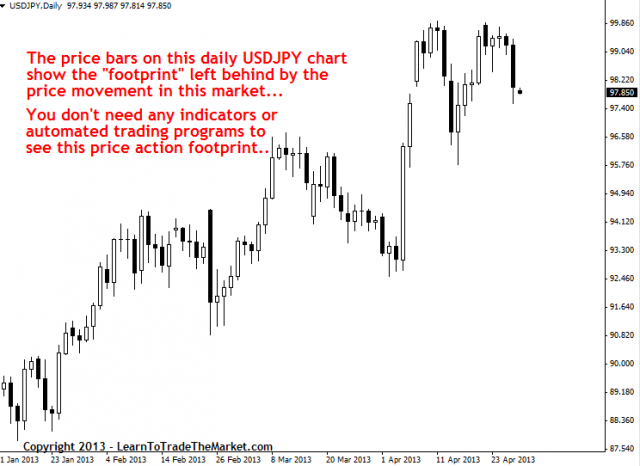
“Price action” is essentially the “footprint” that is left behind as price moves over time, this price action footprint is visible by looking at a “raw” price chart of any market or trading instrument…stocks, commodities, Forex and other markets all have easily accessible price charts that anyone can analyze if they want. This price footprint that is evident on a “naked” or indicator-free price chart is all you really need to make trading decisions, and price action traders use primarily only this price action footprint to analyze and trade the markets.
In the example chart below, we can see the natural and unobstructed “footprint” left behind by the price movement or price action in a market:
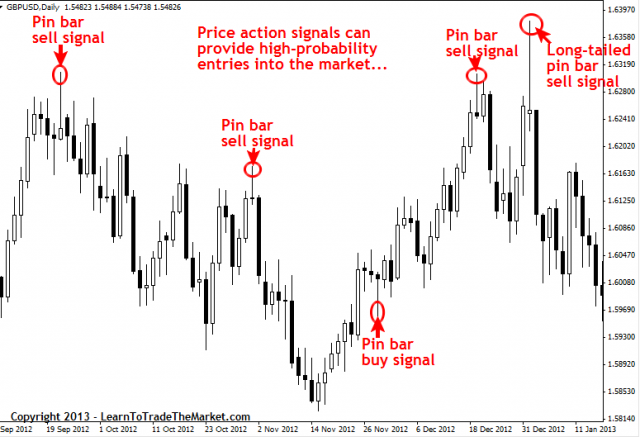
There are specific price action setups or “entry signals” that develop in the context of a market’s price action, and we can use these price action signals as entry points into the market. Essentially, price action trading consists of learning to read a market’s price action and identify high-probability price action entry signals that occur within it.
In the example chart below, we can see one of my favorite price action entry signals, the pin bar reversal:
What does Successful Price Action Forex Trading Involve?
Being able to make money trading with price action strategies is something that takes education, practice and time. Once you really start to understand price action trading, you will see that it is both an “art” and a skill, and it’s the skill that you can learn from my website or others, but it’s the art of trading that you will need time, determination and discipline to develop.
It is this “art” aspect of price action trading that really separates the pros from the amateurs in the Forex market place. The reason being, is that developing your discretionary price action Forex trading skills (sometimes referred to as “gut” trading feel) is what allows you to identify a quality price action setup from one that is not as high probability of a setup. Once you begin to fine-tune this discretionary process of discriminating between trade setups worth risking your money on from ones that are basically just a gamble at best, you become closer to making it as a professional Forex trader.
It is also this discretionary “art” aspect of successful trading that causes most aspiring traders to give up or eventually blow out so many trading accounts that they literally cannot afford to trade anymore. The issue arises because so many traders desperately want to “automate” or program the Forex market, so that they can just sit back on the beach and press one button to make millions of dollars. Unfortunately it takes MOST traders years of trial & error and frustration to figure out that trading simply cannot be quantified or programmed successfully…and that you do need to use your eyes and brain to make discretionary trading decisions.
 The Forex market, and all financial markets for that matter, are simply reflections of the aggregate beliefs of many participants. So when one thinks about trying to program or automate the aggregate beliefs of millions of human beings, it becomes obvious just how futile this can become. This is exactly where price action forex trading comes in. When you learn how to interpret and read what a plain vanilla price chart is telling you, you are literally learning to interpret the most accurate reflection of this human aggregate belief structure. Once you learn the necessary skills involved in price action Forex trading, you can move on to concentrate on practicing and fine-tuning your chart reading so that you get a better understanding of price action forex trading and how to properly apply discretion.
Price action analysis is an art and a skill, you can learn the skill aspect of price action Forex trading from a comprehensive Forex trading training course. However, the “art” part of price action trading is something you need to develop from the skills that you’ve learned, and it comes through screen-time, in other words, through analyzing and trading the markets and putting in the time to learn how to trade.


About Nial Fuller
Nial Fuller is a Professional Trader, Investor & Author who is considered ‘The Authority’ on Price Action Trading. His blog is read by over 200,000+ followers and he has taught 25,000+ students since 2008. In 2016, Nial won the Million Dollar Trader Competition. Checkout Nial's Professional Trading Course here.

0 Comments Leave a Comment